
When Death appears upright
Detailed upright meaning
Something may have reached the end of the form in which you have known it. Death is one of tarot's most misunderstood cards: it is not a prediction of physical death, but an archetype of endings, transition and irreversible change.
You may be outgrowing a role, relationship pattern, ambition or belief that once carried genuine meaning. Recognising completion does not make the experience disposable. An ending can honour what came before while accepting that it cannot continue unchanged. Grief and relief may sit beside each other without cancelling either one.
This card rarely offers the comfort of returning everything to how it was. Its gift is honesty about what has already shifted. Trying to restore the previous version may consume energy needed for adaptation. Ask what is truly ending: the whole relationship, or one way of relating? The goal itself, or the identity built around achieving it? Precision can make transformation feel less like total destruction.
Release is central, but it should not be rushed into a performance of letting go. Some endings need ritual, conversation, practical arrangements and time. You may revisit feelings even after a decision is clear. Emotional recurrence does not mean you have failed to move forward; it can be part of integrating change.
Renewal exists within the card, though it is not always immediately visible. New growth may begin as empty space, uncertainty or the return of energy previously tied to maintaining what was complete. Resist the pressure to fill that space before you understand it. The next chapter deserves to emerge from who you are becoming, not from panic about the blank page.
When Death appears, let truth be gentle and direct. Name what has finished, acknowledge what it meant and release what can no longer travel with you. Transformation is not a demand to become someone entirely different. It may be the removal of what prevented a more honest version of you from having room.
When Death appears reversed
Detailed reversed meaning
An ending may be recognised but not yet fully accepted. Death reversed can reflect resistance to change, a transition unfolding slowly or attachment to a familiar identity beyond its natural life.
Resistance is not weakness. The known world provides orientation, even when it is uncomfortable. You may fear the grief, uncertainty or practical disruption that follows release. Begin by acknowledging what the current arrangement costs. Sometimes you do not need more evidence that something is over; you need support for what comes after admitting it.
The card can also describe a long transition. Outer circumstances may have changed while habits, emotions or self-understanding remain organised around the past. This lag is human. You can respect the pace of integration while taking small actions that belong to the present rather than repeatedly rehearsing the previous chapter.
At times, the reversal points to repeated endings that never quite complete: boundaries announced and withdrawn, possessions retained through guilt, or a goal abandoned in practice but kept alive as self-criticism. Closure is not always granted by another person or a perfect explanation. It may be something you create through a decision, ritual or consistent new boundary.
Stagnation can occur when every change is interpreted as loss. The card does not ask you to celebrate what hurts. It invites you to notice where protecting yourself from one ending also prevents a beginning from receiving energy.
Do not use this card to interpret physical symptoms, predict death or make health decisions. If grief, fear or change feels overwhelming, appropriate personal or professional support matters more than a symbolic reading.
The invitation is compassionate completion. You can move slowly without pretending nothing is changing. Release one attachment, update one choice or speak one truth that helps your outer life reflect the transition already taking place within you.
Death in love
Love and relationships
A relationship or relational pattern may be changing at a fundamental level. Death can mark the end of an old dynamic, allowing a connection to transform—or acknowledging that its present form has completed.
It does not automatically predict a breakup. The ending may involve expectations, roles or habits that prevent honest connection. Reversed, fear of loss may keep an unhealthy pattern in place, or emotional closure may lag behind an external ending. Allow grief its dignity while remaining attentive to the life beyond the former pattern.
Death at work
Career and money
A professional chapter may be ready to change form. Death can reflect an outdated direction, identity or working pattern that no longer supports growth.
Reversed, you may be remaining with the familiar because uncertainty feels more threatening than dissatisfaction. Separate symbolic reflection from practical decisions: review obligations, evidence and options carefully, and seek qualified financial or career guidance where appropriate. The card does not predict job loss or financial outcome.
Death as spiritual guidance
Spiritual guidance
Transformation often begins with making room rather than adding more. Death invites spiritual reflection on impermanence, identity and the freedom that can accompany conscious release.
Reversed, you may be searching for renewal while avoiding the ending it requires. Let grief and uncertainty belong within spiritual life rather than treating them as failures of faith. Presence can be enough before meaning becomes clear.
Reading the traditional image
Imagery and symbolism
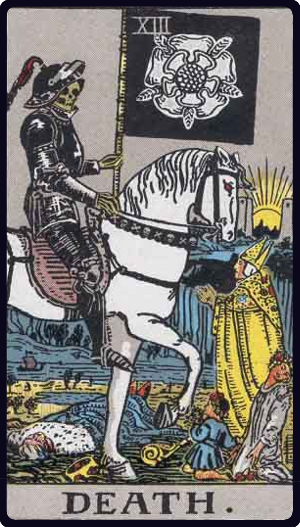
The image shows transformation moving through every level of ordinary life. A skeletal figure rides a white horse beneath a dark banner bearing a white rose, joining mortality with purity, renewal and the persistence of change.
Figures of different status respond to the rider, suggesting that endings are not controlled by rank or preference. A religious figure faces the change while others fall, grieve or turn away, showing varied human responses to the inevitable. In the distance, the sun rises between two towers, offering a subtle horizon beyond the present ending. The river and boat evoke passage from one state to another. The image is stark, but it includes movement, dawn and the possibility of continuation in a new form.
Your moment of reflection
What are you ready to honour, release and stop carrying into your next chapter?
You might like to sit with this question, write without editing for a few minutes, or simply notice what answer keeps returning.