
When Eight of Pentacles appears upright
Detailed upright meaning
You may be developing something valuable through steady, attentive practice. The Eight of Pentacles appears when progress depends less on inspiration and more on returning to the craft with care.
Repetition is central to this card, but it is not mindless. Each attempt gives you information. You notice a detail, correct an error or understand the material more deeply. Mastery grows through this conversation between action and feedback, not through flawless performance from the beginning.
The Eight can represent study, training or the practical stage of learning. Reading and planning have their place, yet some knowledge becomes available only when your hands, voice or judgement engage with the task. Being a beginner may feel exposing, but it also gives you permission to experiment and improve.
Focus creates depth. In a distracted environment, giving one task your full attention can feel almost devotional. This does not require ignoring every other responsibility. It means protecting enough uninterrupted time to enter the work rather than repeatedly circling its surface.
Standards matter here. Craftsmanship is the desire to make something fit for its purpose, not a demand that every detail prove your worth. You can care about quality while recognising when a piece is complete enough to be shared, used or evaluated.
This card may also acknowledge labour that is not glamorous. Much of meaningful work consists of preparation, maintenance and small corrections that others never see. Their invisibility does not make them unimportant. At the same time, dedication should not be used to justify exploitation, inadequate rest or endless unpaid effort.
Ask whether the practice is producing learning. Familiar routines can feel productive while allowing you to avoid the harder edge of development. A helpful teacher, specific feedback or a slightly more demanding challenge may reveal the next area for refinement.
The Eight encourages devotion to process without making productivity your identity. Let the work absorb you, teach you and become more skilful through your care. Then step away when your attention needs restoration. Sustainable mastery includes recovery.
When Eight of Pentacles appears reversed
Detailed reversed meaning
Effort may be present, but it is no longer creating the quality, growth or meaning you need. The Eight of Pentacles reversed can reveal perfectionism, carelessness, burnout or repetition disconnected from purpose.
Perfectionism may look like exceptional dedication from the outside. Inside, it often keeps the work permanently unfinished and every mistake emotionally expensive. If the standard changes each time you approach it, define what the task actually needs. Excellence serves the work; perfectionism asks the work to secure your worth.
At the opposite extreme, you may be rushing, skipping essential steps or giving a task less attention than it deserves. This does not always mean laziness. Boredom, overload, poor instruction or lack of support can all reduce quality. Identify the real obstacle before responding with harsher discipline.
Repetition without reflection is another possibility. You may be completing the same process again and again without receiving useful feedback or increasing the challenge. Experience alone does not guarantee growth. Pause to compare recent work, find the recurring limitation and practise that element deliberately.
Burnout can distort the relationship between effort and result. Longer hours may produce more errors while leaving less energy to learn from them. Rest is not a reward reserved for the end of all work. It is part of maintaining the attention on which good work depends.
The reversal can also indicate misplaced effort. You might be polishing a minor detail while avoiding the central decision, developing a skill you no longer want to use or working hard within a system that offers little room to progress. Dedication is valuable, but it does not make every destination right for you.
External expectations may be shaping the standard. Ask whose approval you are trying to earn and whether that person understands the purpose, constraints or audience of the work. Feedback is most useful when it is relevant and specific, not when it simply reinforces fear of judgement.
The invitation is to restore intention. Reduce the task, seek instruction, take a genuine break or change the practice so that effort can become learning again. More work is not always the answer; better contact with the purpose may be.
Eight of Pentacles in love
Love and relationships
A relationship may deepen through consistent care and willingness to learn about one another. The Eight of Pentacles can reflect the small, repeated actions through which trust and understanding are built.
Reversed, the connection may feel like labour without warmth, or one person may be trying to perfect themselves to earn love. Relationships need attention, but they also need mutuality, ease and room for both people to be human.
Eight of Pentacles at work
Career and money
Skill may be strengthening through training, concentration and high-quality work. The Eight of Pentacles is closely connected with apprenticeships, professional development and pride in a useful craft.
Reversed, burnout, inadequate training or perfectionism may undermine the result. Review workload and expectations rather than assuming greater effort solves every problem. Tarot cannot guarantee employment, income or professional outcomes.
Eight of Pentacles as spiritual guidance
Spiritual guidance
A simple practice may become meaningful through sincere repetition. The Eight of Pentacles invites you to return to what helps you listen, reflect and live your values with greater care.
Reversed, practice may have become a performance or rigid obligation. You can adjust a ritual that no longer brings presence; consistency is valuable only when it keeps you connected to purpose.
Reading the traditional image
Imagery and symbolism
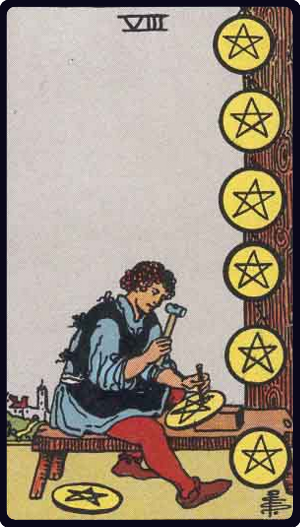
The image shows a craftsperson absorbed in making one pentacle after another. A seated figure uses tools on the piece in their hands while completed pentacles are displayed nearby.
The repeated symbols show accumulation of skill as well as completed work. Tools and a workbench ground the scene in practical technique rather than abstract talent. A distant town suggests the figure has stepped away from ordinary activity to concentrate. Their posture conveys attention, while the unfinished pentacle reminds us that craftsmanship is always occurring in the present attempt.
Your moment of reflection
Which part of your life deserves the kind of practice that makes you more present, not merely more productive?
You might like to sit with this question, write without editing for a few minutes, or simply notice what answer keeps returning.