
When Five of Wands appears upright
Detailed upright meaning
You may be in a situation where several people, priorities or impulses are pushing in different directions. The Five of Wands appears when energy is abundant but coordination is limited.
Not all conflict is harmful. Debate can expose assumptions, competition can reveal capability and a demanding challenge can strengthen skill. The useful question is whether the friction produces learning, clarity or a better result—or whether people are mainly exhausting themselves.
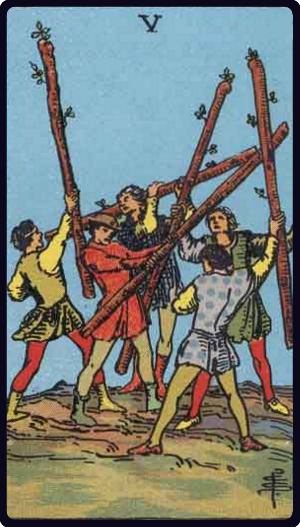
The figures in the traditional image do not appear to be fighting a formal battle. Their wands cross chaotically, and no shared rules are visible. You may be dealing with unclear roles, competing methods or a group in which everyone is contributing effort without agreeing on the aim.
If the challenge is healthy, let it remain bounded. Clear expectations, consent and respect make competition safer. A stimulating exchange can become personal when winning begins to matter more than the work or when someone with greater power defines the contest for everyone else.
The Five can also describe internal competition. Several desires may each demand immediate attention: security and adventure, rest and achievement, independence and belonging. Treating one impulse as an enemy can intensify the struggle. Ask what each part is trying to protect or create.
Comparison may be present. Seeing other people's ability can motivate you, but it can also persuade you that there is only one available place. Their progress provides information, not a verdict on your timing or worth. Return to the standard that serves your own work.
In groups, name the shared objective before arguing about method. People may discover that they are solving different problems or using the same word to mean different things. A small amount of structure can turn scattered effort into productive exchange.
The invitation is to use friction rather than worship it. Enter challenges that help you grow, protect dignity within disagreement and step away when the contest consumes more value than it creates.
When Five of Wands appears reversed
Detailed reversed meaning
The conflict may be avoided, internalised or reaching a point where everyone needs a different way to engage. The Five of Wands reversed can reflect common ground, suppressed tension or struggle that has become repetitive.
You may be tired of disagreement and ready to reduce the noise. Compromise can be wise when it preserves the important parts of each position. It is less useful when one person repeatedly gives up their needs so that everyone else can call the situation peaceful.
Conflict avoidance may create a smooth surface while tension moves into withdrawal, resentment or indirect communication. If the relationship or project matters, name the specific disagreement early enough for it to remain workable. You do not need to turn every preference into a confrontation.
In another expression, the conflict is escalating. The original issue may have become secondary to accumulated frustration, alliances or the need to save face. Return to the question that actually requires a decision. Mediation or a neutral process may help where direct conversation keeps reproducing the same dynamic.
The reversed Five can describe inner tension too. You might spend so much energy debating every possible action that none receives a fair test. Choose a temporary priority and set a review point. A decision can be provisional without being meaningless.
Drained energy is important here. Some environments maintain constant competition because it benefits those controlling the system, not because rivalry improves the outcome. You do not need to prove resilience by remaining in every contest. Collaboration, boundaries or refusal may be more effective responses.
Common ground can emerge, but it should not be assumed. The card does not promise reconciliation. Look for evidence that people are listening, adjusting and sharing responsibility rather than simply pausing until the next argument.
The invitation is to decide which tension deserves engagement. Clarify the rules, address what is unspoken or withdraw energy from conflict that has no meaningful purpose. Peace becomes more trustworthy when it does not require self-erasure.
Five of Wands in love
Love and relationships
Different needs or communication styles may be creating lively friction within the connection. The Five of Wands can reflect teasing competition, repeated disagreements or tension around whose priorities lead.
Reversed, conflict may be easing or going underground. The card does not prove incompatibility or predict a breakup. Notice whether disagreement can happen safely and whether both people can influence the resolution.
Five of Wands at work
Career and money
Competition or conflicting approaches may be shaping the working environment. The Five of Wands can support constructive challenge, pitching ideas and learning through comparison when the rules are fair.
Reversed, politics, unclear ownership or conflict fatigue may reduce good work. Tarot cannot determine workplace rights or financial outcomes. Document relevant facts and seek appropriate professional support where consequences are significant.
Five of Wands as spiritual guidance
Spiritual guidance
Different beliefs can sharpen discernment when disagreement remains curious and humane. The Five of Wands invites you to test ideas without making spiritual certainty a contest.
Reversed, inner or community conflict may be consuming the purpose of practice. Shared language is not true harmony if questions and difference are punished.
Reading the traditional image
Imagery and symbolism
The image shows five figures raising wands in a confused, overlapping exchange. Their clothing is varied, their movements are active and no single direction or leader is apparent.
The crossed wands create visual noise, capturing energy without coordination. The figures may be sparring, competing or trying unsuccessfully to build together; the ambiguity keeps the focus on how tension is organised. Their different clothes suggest distinct viewpoints or roles, while the open ground offers no external obstacle. The central challenge is how the group uses its own energy.
Your moment of reflection
Which tension is helping you grow, and which one is simply asking you to spend energy without creating change?
You might like to sit with this question, write without editing for a few minutes, or simply notice what answer keeps returning.