
When King of Swords appears upright
Detailed upright meaning
You may be asked to make a clear decision whose consequences extend beyond your own preferences. The King of Swords appears when reason, authority and ethical responsibility need to operate together.
The King values evidence. Feelings still matter because they reveal needs, values and human impact, but they are not asked to carry factual claims alone. A strong judgement considers both measurable information and the context in which that information exists.
Authority is central to this card. You may hold formal power, relevant expertise or simply the responsibility to set a direction. Ethical authority explains its reasoning, applies standards consistently and remains accountable for the effects of its choices. It does not treat confidence as a substitute for proof.
The sword can distinguish what belongs together and what needs separating. A complex issue may become easier when roles, criteria or terms are defined precisely. What is the actual question? Who owns the decision? Which facts are agreed, and where does interpretation begin?
Strategic leadership looks beyond the immediate response. The King considers precedent, unintended consequences and what a decision teaches others about how the system works. A convenient exception may solve today's problem while weakening trust tomorrow.
Intellectual discipline also includes revision. Changing a conclusion when evidence changes is not indecision; it is integrity. Expertise becomes dangerous when preserving the image of being right matters more than reaching a sound result.
As a court card, the King may describe a quality within you, another person or the approach a situation needs. It is not tied to gender. Look for structured thought, direct communication, expertise and influence over how decisions are made.
The invitation is responsible clarity. Gather what is relevant, consult where your knowledge ends and choose according to principles you could explain openly. Sound judgement is not emotionless; it is thoughtful enough to account for people as well as logic.
When King of Swords appears reversed
Detailed reversed meaning
Knowledge or authority may be operating without enough fairness, humility or accountability. The King of Swords reversed can reveal manipulation, rigid judgement or expertise used to silence rather than clarify.
Intellectual arrogance may appear as certainty that no one else understands the issue well enough to contribute. Relevant expertise deserves respect, but it does not remove blind spots or ethical obligations. Ask whether questions receive real answers or are dismissed as evidence of ignorance.
Manipulation can involve selective facts, technical language used to confuse or an argument designed to make another person doubt what they can plainly observe. The card does not prove that someone is manipulating you. Focus on verifiable claims, written terms and whether the reasoning remains consistent when challenged.
The reversal may also reflect your own rigidity. A rule or conclusion could once have been sound but now be applied without context. Consistency is valuable; fairness sometimes requires recognising meaningful differences rather than pretending every situation is identical.
Authority can become punitive. A leader may be more interested in demonstrating control than solving the problem, or a decision may protect the institution's appearance at the expense of those affected. Where stakes are significant, documentation, independent advice and formal review may matter more than another informal debate.
At times, the reversed King shows analysis used to avoid feeling. You may construct a flawless explanation while remaining disconnected from the human consequence. Emotion does not need to overrule reason, but excluding it entirely can produce a decision that is technically neat and practically harmful.
Poor judgement is another possibility. Important information may be missing, the source may be unreliable or pressure may encourage a conclusion before proper review. Slow the process where you can. Tarot cannot determine legal, financial, medical or professional facts; relevant qualified expertise belongs in those decisions.
The invitation is accountable intelligence. Make the reasoning visible, test it against evidence and impact, and separate genuine authority from the demand to remain unquestioned. The mind serves best when power can answer for itself.
King of Swords in love
Love and relationships
A relationship may need clear agreements, honest reasoning and respect for each person's perspective. The King of Swords can reflect mature communication and decisions made according to shared principles rather than passing pressure.
Reversed, one person's logic may dominate or emotion may be treated as inherently invalid. The card does not diagnose manipulation. Notice whether both people can question, disagree and influence the terms of the relationship.
King of Swords at work
Career and money
Expertise, strategy and fair standards may help you make a strong professional decision. The King of Swords supports structured leadership, careful analysis and communication that makes responsibilities clear.
Reversed, misuse of authority or flawed reasoning may need independent scrutiny. Tarot cannot verify legal, employment or financial claims. Review the evidence and seek suitably qualified advice before consequential decisions.
King of Swords as spiritual guidance
Spiritual guidance
Spiritual integrity may require principles strong enough to apply even when certainty feels comforting. The King of Swords invites study, ethical reflection and responsibility for the influence your beliefs carry.
Reversed, a teacher or system may present authority as immunity from questions. A trustworthy path does not need manipulation, obscurity or intellectual humiliation to preserve its truth.
Reading the traditional image
Imagery and symbolism
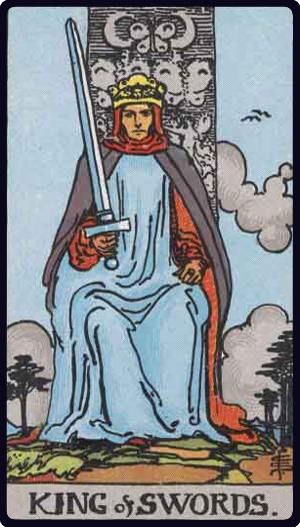
The image shows a crowned figure seated directly forward with an upright sword in one hand. The throne is decorated with butterflies and crescent shapes while trees and clouds move in the distance.
The frontal posture suggests direct authority and readiness to judge what is presented. The vertical sword represents truth and structured thought, held firmly but not in active attack. Butterflies connect mental discipline with transformation, while the crescent motifs suggest intuitive information existing beside reason. The moving landscape keeps the apparently stable throne within a changing world, reminding authority that context continues to evolve.
Your moment of reflection
What decision would you make if your reasoning, principles and impact all needed to withstand honest examination?
You might like to sit with this question, write without editing for a few minutes, or simply notice what answer keeps returning.