
When Seven of Swords appears upright
Detailed upright meaning
You may be approaching a difficult situation indirectly because openness feels risky, unwise or inconvenient. The Seven of Swords appears when strategy, privacy and honesty need to be distinguished carefully.
This card is often labelled deception, but it does not prove that someone is lying, cheating or acting against you. Tarot cannot reveal hidden facts or another person's private intentions. It can, however, invite you to examine observable gaps between words, actions and available evidence.
Strategy is not automatically dishonest. You may need to protect a developing idea, plan a careful exit or choose what to disclose in an environment that has not earned full access. Privacy is a boundary; deception deliberately creates a false understanding. The difference lies partly in what is owed, what has been agreed and who carries the consequences.
Acting alone may feel efficient. Collaboration can introduce questions, compromise and the possibility of being stopped. Yet avoiding other people's input also removes expertise and accountability. Ask whether independence is serving the goal or protecting the plan from information you do not want to hear.
The card may expose indirect communication. You might hint, withdraw or arrange circumstances in the hope that someone understands without requiring you to state the difficult thing. Indirectness can feel safer, but it often asks others to interpret what you could express more clearly.
There are also situations where direct confrontation is unsafe or likely to be used against you. Quiet planning can be an intelligent form of self-protection. If the issue involves coercion, abuse, retaliation or essential resources, seek specialist support rather than allowing a symbolic card to dictate disclosure.
The Seven asks you to assess the plan beyond the immediate escape. What happens when the missing information is discovered? Can the approach withstand explanation later? A clever short-term solution may create a longer problem if it depends on others remaining uninformed.
The invitation is ethical strategy. Protect what genuinely needs discretion, verify suspicions through evidence and be honest where another person's consent or choices depend on the truth. Intelligence becomes wisdom when it accounts for impact as well as advantage.
When Seven of Swords appears reversed
Detailed reversed meaning
A strategy built on avoidance or incomplete truth may be becoming difficult to maintain. The Seven of Swords reversed can reflect disclosure, accountability, self-deception or recognition that the current plan is not working.
You may be ready to admit something, correct a misleading impression or ask for help after trying to manage alone. Honesty does not erase impact, but it can stop further distortion. Choose direct language and avoid turning the confession into a request that the other person immediately comfort you.
The reversal can also point inward. You may be carefully avoiding a fact that does not fit the story you prefer. Self-deception is rarely simple foolishness; it often protects hope, identity or belonging. Approach the contradiction with enough compassion to see it and enough honesty to act on what you find.
An exposed plan is another traditional meaning, though the card should not be used to predict that someone gets caught. More usefully, consider what happens if the current approach becomes visible. If that thought creates immediate alarm, the strategy may need an ethical or practical review.
At times, you may be unfairly suspicious. Past experiences can make ordinary privacy feel threatening or encourage you to search for hidden meaning in every inconsistency. Return to observable behaviour, ask reasonable questions and accept that uncertainty is not evidence of wrongdoing.
The reversed Seven may also encourage a change of method. A private plan, indirect conversation or solo effort might have reached its limit. Bringing in a trusted person can provide perspective, expertise or accountability without making every detail public.
If you have been deceived, avoid blaming yourself for trusting information presented as true. Responsibility belongs with the person who chose the deception. Your task is to decide what evidence, boundary or support helps restore agency now.
The invitation is to reduce the distance between what is known, said and done. Repair where appropriate, revise the strategy where necessary and keep privacy where it protects dignity rather than obscures another person's right to choose.
Seven of Swords in love
Love and relationships
Privacy, indirectness or uneven honesty may be affecting trust within the connection. The Seven of Swords can reflect avoidance or a need to protect personal space, but it does not confirm infidelity or deception.
Reversed, a difficult truth may be ready for direct conversation or suspicion may need checking against evidence. Notice consistency, ask clear questions and do not use tarot as proof of another person's conduct.
Seven of Swords at work
Career and money
Careful strategy may be useful when information, timing or workplace politics require discretion. The Seven of Swords can support independent thinking while warning against plans that depend on hidden terms or missing consent.
Reversed, an overlooked detail or weak strategy may require correction. Tarot cannot verify fraud, workplace conduct or financial claims. Document facts and seek qualified professional or legal guidance when consequences are significant.
Seven of Swords as spiritual guidance
Spiritual guidance
Discernment may ask you to separate sacred privacy from secrecy that protects unaccountable power. The Seven of Swords invites thoughtful boundaries alongside honest examination.
Reversed, a belief or teacher may need closer scrutiny, or you may be ready to admit where a spiritual explanation has helped you avoid reality. Trustworthy practice leaves room for questions and informed choice.
Reading the traditional image
Imagery and symbolism
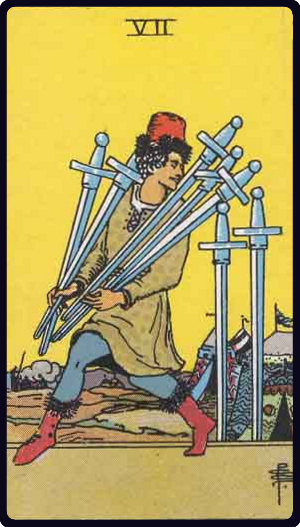
The image shows a figure carrying five swords away while glancing back at two left behind. Tents stand in the background, and the figure moves carefully with an expression that can be read in several ways.
The tiptoeing posture suggests stealth, strategy or awareness of risk. Five carried swords imply a substantial gain, yet the two remaining swords show that the plan is incomplete. The backward glance can suggest caution, guilt or calculation without settling motive. A distant group near the tents reminds us that the action occurs within a wider community and may affect people who are not present to respond.
Your moment of reflection
Where does discretion protect something important, and where might greater honesty create a more sustainable path?
You might like to sit with this question, write without editing for a few minutes, or simply notice what answer keeps returning.