
When Six of Pentacles appears upright
Detailed upright meaning
You may have something useful to offer, or be ready to accept support that helps restore balance. The Six of Pentacles appears when time, money, knowledge, access or care is being shared.
Generosity becomes meaningful through attention. Rather than assuming what another person needs, ask when possible. Help that respects choice allows the recipient to remain the authority on their own life. The card is less interested in the performance of being generous than in whether the resource reaches the need.
If you are in a position to give, consider both capacity and motive. You can contribute warmly without emptying yourself, rescuing everyone or expecting closeness in return. Clear limits make generosity more sustainable. They also distinguish a genuine gift from an unspoken contract.
If you are receiving, the Six can invite you to do so without translating need into shame. Circumstances shift, and most people move between giving and receiving across a lifetime. Reciprocity does not always happen immediately or between the same two people. Care can circulate through a community in many directions.
Power remains present even in kind exchanges. The person controlling a resource may also influence its terms, timing and distribution. Fairness therefore requires more than good intentions. Notice who decides what counts as deserving, who has to disclose private difficulty and who receives trust without having to prove themselves.
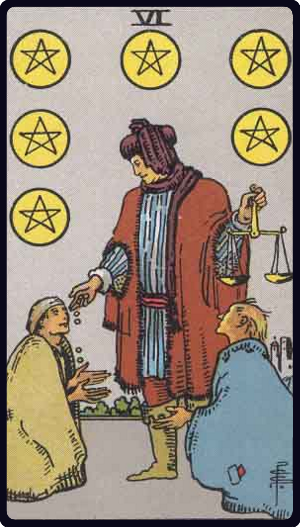
The scales in the card suggest discernment, but fairness does not always mean identical portions. Different needs may call for different support. An equitable response pays attention to context instead of using sameness to avoid thoughtful judgement.
This card can also concern recognition and compensation. Appreciation is valuable, but it should not be substituted for appropriate pay, credit or contribution where those are due. Likewise, sharing knowledge or opening a door for someone can be a practical form of generosity when money is not the relevant resource.
The Six invites conscious circulation. Give where you have genuine capacity, receive where support is appropriate and stay awake to the power within the exchange. The healthiest generosity leaves dignity, clarity and choice intact.
When Six of Pentacles appears reversed
Detailed reversed meaning
An exchange may look generous while carrying imbalance, obligation or hidden terms. The Six of Pentacles reversed asks you to examine where resources and power are not moving fairly.
Support can come with strings attached. A favour may later be used to demand loyalty, access, gratitude or silence. If the conditions were never stated, you are allowed to question them. A gift does not purchase control over another person's decisions.
You may instead be overgiving. Perhaps you contribute beyond your capacity because being needed feels safer than disappointing someone, or because you hope care eventually earns care in return. Generosity cannot reliably communicate a need you have not named. Consider what you are freely choosing, what you resent and what would be better expressed as a direct request.
The reversal can also show receiving that has become uncomfortable or exploitative. Dependence is not a moral failure, yet a significant power imbalance deserves clear eyes. Where possible, understand the terms, protect your choices and seek independent advice when an arrangement affects housing, employment, debt or other essential resources.
In workplaces and groups, resources may be distributed according to visibility, favour or status rather than contribution and need. Someone may receive credit while another carries unseen labour. Naming the pattern with specific examples can be more effective than debating whether everyone meant well.
At times, the card points to withheld generosity. You might have capacity to help but fear there is never enough, or you may be protecting resources after feeling used. Neither automatic giving nor automatic refusal creates fairness. Let current evidence and honest limits shape the decision.
There can also be self-interest disguised as service: offering only where the gesture enhances reputation, maintaining dependence to feel powerful or speaking for people rather than making space for them. The reversal invites accountability without requiring perfection. Motives can be mixed; what matters is becoming more honest about their effect.
The task is to make the exchange clearer. State terms, review consent, recognise labour and step away from arrangements that rely on guilt. Support is most nourishing when it expands agency instead of reducing it.
Six of Pentacles in love
Love and relationships
Care may be expressed through practical generosity and a willingness to receive in return. The Six of Pentacles can reflect partners, friends or family sharing resources according to capacity and need.
Reversed, one person may control the terms, keep score or give until resentment builds. Equality does not require identical contributions, but both people need dignity, voice and freedom from coercion.
Six of Pentacles at work
Career and money
Resources, recognition or opportunity may be shared in a way that deserves careful attention. The Six of Pentacles can relate to fair compensation, mentorship, assistance or considered generosity.
Reversed, unpaid labour, unclear debt or conditional support may be present. Tarot cannot assess a loan, contract, donation or investment; check the actual terms and seek qualified guidance before making consequential financial choices.
Six of Pentacles as spiritual guidance
Spiritual guidance
Generosity can become a spiritual practice when it honours dignity rather than hierarchy. The Six of Pentacles asks you to see giving and receiving as parts of the same human circulation.
Reversed, spiritual generosity may be used to create obligation or demonstrate superiority. Choose communities where support is transparent and questions about money, access and authority are welcome.
Reading the traditional image
Imagery and symbolism
The image shows a measured distribution of resources between people in unequal positions. A richly dressed figure holds balanced scales while placing coins into the hands of one kneeling person; another waits nearby.
The scales suggest fairness and discernment, while the coins make assistance tangible. Yet the standing and kneeling figures reveal a clear difference in power. The giver chooses how much and to whom, inviting questions about criteria, dependence and dignity. The second waiting figure reminds us that even generous resources may be limited or selectively distributed.
Your moment of reflection
Where could giving or receiving become more honest, more balanced and more respectful of everyone's agency?
You might like to sit with this question, write without editing for a few minutes, or simply notice what answer keeps returning.