
When Ten of Cups appears upright
Detailed upright meaning
You may be recognising a form of happiness that becomes more meaningful because it is shared. The Ten of Cups completes the numbered journey of the suit with belonging, emotional continuity and connection that extends beyond one private moment.
The card is often associated with family, but family should be understood broadly. It may include relatives, partners, friends, chosen family or a community in which care and responsibility travel across time. The important quality is not a conventional structure. It is the experience of being able to participate without earning your place through constant performance.
Harmony here is not an absence of disagreement. Lasting connection depends on the ability to repair, respect difference and remain curious about one another. A peaceful appearance maintained through silence is not the same as emotional safety.
The Ten may reflect a milestone or a period when relationships feel particularly supportive. Let yourself recognise that support. If you are accustomed to self-reliance, belonging can require the vulnerable act of allowing your life to matter to other people.
Shared values are important. People do not need identical beliefs, but a relationship or community becomes steadier when there is broad agreement about honesty, respect and how power is handled. Consider which values are visible in behaviour, not only spoken in theory.
This card can also describe the future you are consciously helping to create. Everyday choices—how conflict is approached, whose needs are noticed and whether joy is made welcome—form the emotional culture of a home or group.
The Ten of Cups is not a prediction of marriage, children or a perfect family. It honours fulfilment without prescribing its form. When it appears, notice where belonging already exists and what helps it remain spacious enough for everyone involved.
When Ten of Cups appears reversed
Detailed reversed meaning
The expectation of harmony may be making honest connection harder. The Ten of Cups reversed can reveal tension within a family or community, particularly when appearances are protected at the expense of truth.
You may feel pressure to preserve a happy image, avoid conflict or meet a traditional definition of belonging that does not fit your life. The card asks whose comfort the ideal protects and what becomes possible when the emotional reality can finally be named.
Differing values may have become significant. Affection can remain while choices, boundaries or beliefs move in incompatible directions. Not every difference needs resolution, but some require clear limits. Belonging should not demand participation in behaviour that conflicts with your safety or integrity.
The reversal may also reflect disappointment with family life because it does not resemble the imagined version. Real relationships include fatigue, misunderstanding and ordinary imperfection. Ask whether the problem is a harmful pattern or a human connection being measured against an impossible picture.
At times, you may be grieving a family or community you did not receive. That loss deserves acknowledgment. Chosen family and new forms of belonging can be meaningful without erasing what was missing.
Hidden conflict cannot be repaired while everyone agrees not to see it. Honest conversation may help, but it should be proportionate to safety. Where abuse, coercion or serious family conflict is present, specialist support matters more than pressure to reunite or forgive.
The invitation is to replace idealised harmony with genuine relationship. Clarify values, make space for complexity and invest in connections where truth does not cancel belonging.
Ten of Cups in love
Love and relationships
A partnership may feel connected to a wider sense of home, belonging or shared future. The Ten of Cups can reflect emotional security, supportive community and happiness built through continuing care.
It does not predict marriage, pregnancy or children. Reversed, private tension may contrast with a polished appearance, or partners may hold different visions of family and future. Bring those values into honest conversation rather than assuming love resolves them automatically.
Ten of Cups at work
Career and money
Work may feel more fulfilling when it supports the life and relationships that matter beyond it. The Ten of Cups can reflect a supportive team, shared purpose or healthy integration between work and home.
Reversed, workplace culture may promise belonging while discouraging honest difference, or professional demands may strain personal connection. Review practical boundaries and use qualified guidance for financial decisions; emotional optimism does not establish security.
Ten of Cups as spiritual guidance
Spiritual guidance
Belonging can be a spiritual experience when it is rooted in mutual care. The Ten of Cups invites gratitude for connection, shared ritual and the ways love becomes visible through ordinary life.
Reversed, spiritual or family ideals may be used to enforce conformity. A meaningful community can hold questions, boundaries and diverse lives without treating them as threats.
Reading the traditional image
Imagery and symbolism
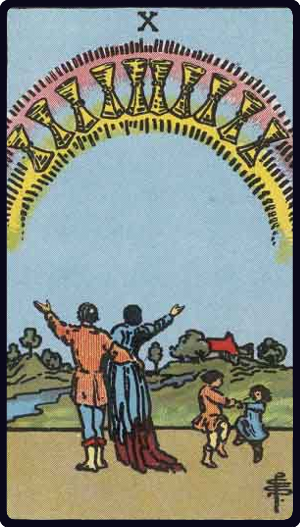
The image presents emotional abundance as something witnessed and shared across generations. Two adults raise their arms towards a rainbow of ten cups while two children play nearby.
A home, trees and river create a fertile landscape of continuity and everyday security. The rainbow traditionally suggests blessing and hope after difficulty, while the arranged cups form an arc over the whole scene. The figures face the landscape rather than the viewer, placing emphasis on shared experience rather than display. At the same time, the idealised scene invites a useful question: which parts represent genuine belonging, and which reflect cultural expectations about what happiness should look like?
Your moment of reflection
Where do you feel you can belong without having to make your life look perfect?
You might like to sit with this question, write without editing for a few minutes, or simply notice what answer keeps returning.