
When Ten of Swords appears upright
Detailed upright meaning
You may be confronting an ending that leaves little room for pretending the old form can continue unchanged. The Ten of Swords appears when a situation, belief or pattern has reached its limit.
The image is dramatic, but it should never be read as a prediction of physical death, violence or catastrophe. Tarot is symbolic, and this card more often reflects emotional finality, mental exhaustion or the collapse of a story that can no longer be sustained.
An ending can feel brutal even when it has developed slowly. You may have noticed warning signs, attempted repairs or carried the situation beyond your capacity because the alternative felt too painful. Reaching the limit does not necessarily mean you failed. It may reveal how much you tried before recognising that the terms themselves were no longer workable.
The Ten can also represent the collapse of an interpretation. A truth may make it impossible to return to an earlier understanding of a person, institution or part of yourself. This loss of innocence can be disorienting, but clarity prevents further investment in something that exists mainly through denial.
There is no need to rush towards the silver lining. Shock, anger, grief or emptiness deserve room before the ending is converted into a lesson. Gentle honesty is enough: this happened, it affected me and I do not need to know the whole meaning yet.
The card sometimes carries a sense of total defeat. Notice language such as “everything is ruined” or “nothing can change”. The situation may indeed contain a major loss, but pain tends to speak in absolutes. Identify what has ended specifically and what remains, even if what remains is only the next hour, one supportive person or a decision not to continue the same harm.
Finality can create a boundary that indecision could not. Once the old option is no longer available, energy may eventually move towards recovery, repair or a different direction. This is not a promise of instant renewal. It is recognition that an ending stops demanding the labour of keeping an unsustainable form alive.
The invitation is acceptance without abandonment of yourself. Let the ending be real, seek practical and emotional support, and resist using this card to frighten yourself about what comes next. The conclusion of one chapter is not a verdict on your future worth.
When Ten of Swords appears reversed
Detailed reversed meaning
You may be beginning to rise after a painful ending, even while its effects remain close. The Ten of Swords reversed can represent survival, gradual recovery or difficulty accepting that something is over.
Recovery may not look inspiring. It can begin as the absence of further damage, a little more energy or one decision that protects you from repeating the same pattern. Small signs matter because they show that the ending is no longer the only event taking place.
The reversal can also reveal resistance. You might be attempting to revive a role, relationship or belief whose essential form has already ended. This does not make your attachment foolish. Endings disturb identity and routine as well as hope. Ask whether the effort is creating something genuinely new or postponing the grief of what was lost.
Lingering pain may remain after the practical situation has concluded. Your mind could continue replaying the final moment or searching for the point at which a different choice might have changed everything. Reflection can provide learning, but endless reconstruction may become another way of staying inside the event.
There may be fear that recovery minimises the seriousness of what happened. Feeling interest, pleasure or hope again does not excuse harm or erase the past. It shows that your life contains more than the injury. You are allowed to move without proving that the ending no longer matters.
In another expression, a feared collapse has been narrowly avoided. Use the reprieve to examine what brought the situation to its limit. Returning immediately to the same demands without changing the conditions can recreate the crisis in another form.
If the card touches trauma, severe distress, self-harm, violence or danger, tarot is not the right form of support on its own. Contact appropriate emergency, crisis or professional services in your location. The imagery should never be treated as an instruction, diagnosis or prediction.
The invitation is to protect the life that continues beyond the ending. Accept suitable help, make one stabilising choice and allow renewal to be gradual. Survival does not need to look graceful to be real.
Ten of Swords in love
Love and relationships
A relational pattern or connection may feel painfully finished or fundamentally changed. The Ten of Swords can reflect an ending, betrayal already known or the exhaustion of repeating the same hurt, but it does not predict either event.
Reversed, recovery or reconsideration may be occurring. Reconciliation is not automatically the healthier outcome. Let accountability, safety and sustained behaviour—not fear of finality—inform what happens next.
Ten of Swords at work
Career and money
A role, project or professional expectation may have reached a difficult conclusion. The Ten of Swords can reflect closure, burnout-like exhaustion or the collapse of a plan that no longer works.
Reversed, rebuilding may begin through realistic assessment and support. Tarot cannot diagnose burnout or predict employment and financial outcomes. Use workplace processes, accurate records and qualified advice for decisions affecting your security.
Ten of Swords as spiritual guidance
Spiritual guidance
A belief or spiritual identity may be ending because it can no longer contain what you know. The Ten of Swords invites honesty without demanding that you find immediate meaning in the loss.
Reversed, a new relationship with spirituality may emerge slowly after disillusionment. Avoid teachings that turn suffering into proof of special destiny or pressure you to bypass grief with instant gratitude.
Reading the traditional image
Imagery and symbolism
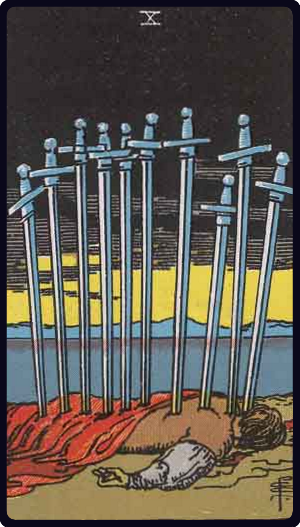
The image uses an extreme scene to portray unmistakable finality rather than literal prediction. A figure lies beneath a dark sky with ten swords in their back, covered partly by a red cloth as calm water and distant land sit beyond them.
The number of swords exaggerates the sense that the situation is completely over; nothing more needs to be added to make the point. The raised hand forms a gesture sometimes associated with blessing or peace, introducing dignity within defeat. A golden dawn appears beneath the dark clouds, while still water lies beyond the foreground. These details suggest continuation after an ending without denying the severity of the present image.
Your moment of reflection
What becomes available when you stop asking an ending to become anything other than true?
You might like to sit with this question, write without editing for a few minutes, or simply notice what answer keeps returning.