
When The Devil appears upright
Detailed upright meaning
Something may feel impossible to resist, escape or examine honestly. The Devil appears when a pattern has become powerful through repetition, secrecy, fear or the belief that you have no meaningful choice.
This card is not evidence of evil, punishment or a supernatural threat. It describes recognisably human experiences: craving approval, staying attached to a harmful dynamic, pursuing pleasure beyond the point of nourishment or allowing shame to keep a behaviour hidden. Its purpose is awareness, not condemnation.
Desire itself is not presented as wrong. Pleasure, ambition, sexuality and material comfort can belong to a full life. The question is whether you remain in relationship with choice. Does the desire expand your experience, or does everything else increasingly organise itself around satisfying, avoiding or concealing it?
The Devil can expose a limiting story: that you are powerless, unworthy or permanently defined by a previous choice. Such beliefs can feel factual because they have been repeated internally or reinforced by others. Naming them creates distance. A thought can influence you without becoming your identity.
Power dynamics may also be relevant. A person, institution or relationship can benefit from convincing you that alternatives do not exist. Look for pressure, secrecy, dependency and consequences attached to questioning the arrangement. Personal reflection matters, but responsibility should not be shifted away from someone misusing power.
Shame tends to strengthen the chains in this card. Honest accountability is different. It names behaviour and impact while preserving the possibility of change. If the pattern involves addiction, coercion, abuse or mental health, appropriate professional or specialist support may be essential; tarot is not a treatment or safety plan.
When The Devil appears, begin with truth that is specific enough to be useful. What happens, what triggers it and what need does it temporarily meet? You do not need to declare yourself free before you are ready. Seeing the chain clearly is already a movement towards choice.
When The Devil appears reversed
Detailed reversed meaning
You may be recognising where choice still exists within a powerful pattern. The Devil reversed often reflects awareness, release or the difficult early work of no longer cooperating automatically with what confines you.
Insight can feel liberating and uncomfortable at once. Once a pattern is visible, its costs become harder to ignore. You may grieve time, trust or energy that has been invested in it. Avoid turning that grief into another source of shame. Recognition arrived when it became possible; what matters now is the support and action available from here.
Releasing an attachment is rarely a single moment. Familiar behaviour may return under stress, and an old belief may remain emotionally convincing after you have challenged it intellectually. A recurrence does not erase progress. It can show where additional support, boundaries or alternative ways of meeting a need are required.
The reversal may also describe denial disguised as freedom. Declaring that something no longer affects you can become another way to avoid its impact. Look for evidence in choices, relationships and the amount of mental space the pattern still occupies. Genuine release tends to create more honesty, not less.
Sometimes The Devil reversed concerns accepting a disowned part of yourself. Desire, anger or ambition may become less disruptive when acknowledged without either obeying or demonising it. Integration gives you more options than suppression.
If another person is controlling or harming you, the solution is not simply to think differently. Safety, trusted support and specialist guidance matter. The card should never be used to blame someone for being trapped or to promise that awareness alone can remove structural or practical barriers.
The invitation is to reclaim choice in realistic increments. Tell the truth to someone safe, interrupt one automatic response or remove one source of access. Freedom can begin before the pattern has completely disappeared.
The Devil in love
Love and relationships
Attraction or attachment may need to be distinguished from genuine intimacy. The Devil can reflect intense chemistry, dependency, secrecy or a dynamic maintained by fear rather than mutual freedom.
It does not label desire as shameful. It asks whether consent, respect and choice remain intact. Reversed, a pattern may be recognised and boundaries may be strengthening. If coercion, control or abuse is present, prioritise safety and specialist support rather than using tarot to explain or repair the other person's behaviour.
The Devil at work
Career and money
An ambition, status symbol or financial fear may be exerting too much influence. The Devil can reveal work that rewards you while narrowing the rest of your life, or spending and earning patterns tied closely to worth.
Reversed, you may be redefining success or interrupting an unhealthy arrangement. Avoid abrupt financial decisions based on a reading. Examine contracts, consequences and options with reliable information and qualified advice.
The Devil as spiritual guidance
Spiritual guidance
Shadow becomes less controlling when it can be met without shame. The Devil invites spiritual honesty about appetite, fear, power and the parts of yourself that polished practices may exclude.
Reversed, you may be releasing beliefs built on fear or punishment. Choose practices that strengthen responsibility and freedom rather than claiming that ordinary desire makes you impure or spiritually unsafe.
Reading the traditional image
Imagery and symbolism
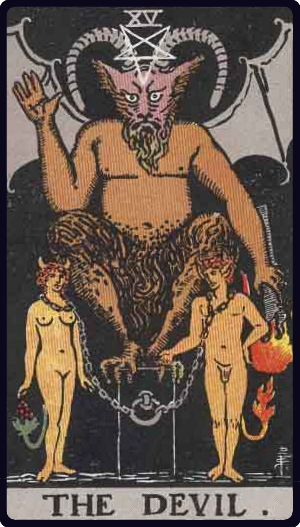
The image uses confronting symbols to reveal bondage that is partly maintained through belief and attachment. A horned, winged figure presides above two chained human figures, echoing The Lovers in a darker, constrained form.
The chains appear loose enough to remove, suggesting available choice, though the image should not be used to minimise real coercion or dependency. The figures have grown horns and tails, implying identification with the environment that confines them. An inverted pentagram above the central figure can symbolise material or instinctive concerns dominating conscious values. The raised and lowered hands mimic a distorted blessing, while the torch points downward. The scene asks what becomes normal when a pattern remains unquestioned—and what awareness might begin to loosen.
Your moment of reflection
What becomes less powerful when you name it without shaming yourself?
You might like to sit with this question, write without editing for a few minutes, or simply notice what answer keeps returning.