
When The Hierophant appears upright
Detailed upright meaning
You may benefit from knowledge that has been tested, shared and practised before you arrived. The Hierophant represents learning within a tradition, community or established framework.
In a culture that prizes originality, this card remembers that few people begin entirely alone. Teachers, rituals, institutions and shared language can provide a foundation from which deeper understanding becomes possible. You may be ready to study with greater commitment, seek an experienced guide or return to principles that bring coherence to your choices.
The Hierophant also asks what belonging means to you. A community can offer recognition, support and the comfort of participating in something larger than individual preference. Shared practices may hold you through periods when personal motivation is low. Yet belonging is most nourishing when it does not require you to abandon your questions or disguise important parts of yourself.
This card is concerned with values made visible. It may invite you to examine whether your routines, relationships and commitments reflect what you say matters. A belief becomes more than an idea when it shapes how you treat people, use resources and respond when doing the easier thing conflicts with doing the more aligned thing.
Guidance may be useful now, particularly in an area where expertise matters. A good teacher does not demand dependence. They help you develop context, skill and discernment of your own. Look for guidance that welcomes thoughtful questions, acknowledges limits and behaves consistently with its stated principles.
When The Hierophant appears, you are not being told to follow convention automatically. You are invited to understand the structure before accepting, adapting or rejecting it. There may be genuine wisdom in repetition, ceremony and patient study. Let tradition become a conversation you participate in consciously rather than a script you perform without reflection.
When The Hierophant appears reversed
Detailed reversed meaning
A rule, belief or source of authority may no longer deserve automatic obedience. The Hierophant reversed invites you to question what you inherited and decide what remains true through lived experience.
You may feel constrained by expectations about the right way to work, love, succeed or be spiritual. Perhaps the structure once offered belonging but now requires too much self-editing. Questioning it can bring relief alongside uncertainty. When an old framework loosens, you may need time to discover which values were genuinely yours and which were followed because acceptance depended on them.
Reversal does not make every tradition harmful or every unconventional path wise. Rejecting a rule automatically can leave it controlling you through opposition. The deeper work is discernment: understanding the purpose a teaching served, noticing its effect and choosing consciously rather than reactively.
This card can also warn against unearned authority. A confident teacher, community or spiritual figure may present personal opinion as universal truth. Pay attention to whether questions are welcomed, power is accountable and consent remains intact. No symbolic system, including tarot, should be used to override your judgement or another person's autonomy.
At other times, The Hierophant reversed reflects the loneliness of creating a path without familiar approval. You may value community but struggle to find one spacious enough for your questions. Seek people connected by honest principles rather than perfect agreement. Belonging can be built around curiosity, mutual respect and the freedom to change.
Your personal philosophy does not need to be final. Let it be informed by study, experience and humility. Keep the wisdom that helps you live with greater integrity, revise what has become restrictive and remain open to learning from voices beyond your own.
The Hierophant in love
Love and relationships
Shared values and clear commitments may matter more than appearances. The Hierophant can represent a relationship shaped by tradition, formal commitment or a shared understanding of what partnership means.
It may invite a conversation about expectations inherited from family, culture or past relationships. Reversed, a connection may not fit a conventional model, or external approval may be exerting too much influence. The important question is not whether a relationship looks traditional, but whether its agreements are mutual, honest and supportive of the people within it.
The Hierophant at work
Career and money
Learning from an established system may help you build competence and context. The Hierophant supports education, mentorship, professional standards and institutions with clearly defined practices.
Reversed, bureaucracy or an inflexible workplace may conflict with your values, or you may be ready to take a less conventional route. Understand practical consequences before rejecting useful structure. With money, examine inherited beliefs about worth, security and success, while relying on qualified guidance for consequential decisions.
The Hierophant as spiritual guidance
Spiritual guidance
Tradition can be a doorway when you enter it consciously. The Hierophant may encourage study, ritual or participation in a community that gives spiritual questions depth and context.
Reversed, you may be reclaiming spirituality from a system that felt restrictive or discovering beliefs through direct experience. Freedom does not require abandoning discernment. Let practices be measured by whether they cultivate presence, compassion and personal responsibility rather than fear or dependence.
Reading the traditional image
Imagery and symbolism
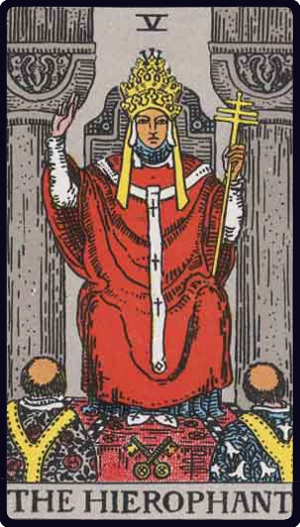
The image places spiritual authority within an organised tradition. The Hierophant sits between two stone pillars, raising one hand in blessing while holding a triple cross associated with layers of spiritual authority.
Two figures kneel before him, suggesting teaching, initiation and knowledge passed through relationship. Crossed keys at his feet can represent access to mysteries and the meeting of conscious and hidden understanding. His elaborate robes and crown emphasise office and ceremony rather than private revelation. The scene asks you to consider both the gifts and responsibilities of inherited authority: who holds knowledge, how it is shared and whether its structures support genuine growth.
Your moment of reflection
Which beliefs feel deeply true to you, and which have simply been handed down?
You might like to sit with this question, write without editing for a few minutes, or simply notice what answer keeps returning.