
When Five of Swords appears upright
Detailed upright meaning
You may be dealing with a conflict in which being right and reaching a useful outcome are no longer the same thing. The Five of Swords appears when tension has become organised around victory, control or self-protection.
This card does not automatically assign the role of aggressor or victim. You may recognise yourself in the person gathering the swords, in those walking away or in the wider atmosphere created by the dispute. Sometimes several positions are present within the same experience: you can feel wronged and still regret how you responded.
The Five asks what the conflict is truly about. The stated issue may sit above a deeper struggle for respect, safety, recognition or authority. If every disagreement becomes a test of who matters most, even a small conversation can acquire stakes it cannot reasonably carry.
There are situations in which firmness is necessary. Refusing mistreatment, documenting behaviour or defending an important boundary is not a hollow victory simply because someone dislikes it. The card should not pressure you to remain agreeable in an unsafe or exploitative dynamic. Discernment matters more than keeping peace at any price.
At the same time, tactics have consequences. Humiliation, threats, selective facts or cleverness used to overwhelm another person may secure compliance while destroying trust. Ask whether the method reflects the values you hoped to defend. A point proved at someone else's expense may leave little foundation for what happens afterwards.
The Five can also reveal a conflict you cannot resolve alone. Another person may not be interested in good-faith conversation, or the power imbalance may make direct engagement unwise. Walking away, seeking mediation or using formal support can be more effective than continuing to argue on terms designed to exhaust you.
If you hold greater power in the situation, consider whose voice is missing and whether agreement is freely given. If you hold less, avoid judging yourself for choosing protection over perfect expression. Conflict looks different depending on what each person risks.
The invitation is to choose your aim consciously. Decide what needs defending, what can be released and what kind of person you want to be within disagreement. Not every contest deserves your participation, and not every victory is worth its cost.
When Five of Swords appears reversed
Detailed reversed meaning
The conflict may be ready for repair, or its unresolved effects may be returning for attention. The Five of Swords reversed can indicate reconciliation, accountability or a pattern of hostility that has only gone quiet on the surface.
You may be tired of carrying the argument. Releasing resentment does not require denying what happened or restoring a relationship. It can mean withdrawing your energy from repeated mental debate and deciding what boundary, consequence or understanding now serves you.
Repair is possible when it is supported by honesty. A useful apology names the action, recognises the impact and allows the harmed person freedom in how they respond. Regret that mainly seeks immediate reassurance can place another burden on the person already affected.
If you are considering reconciliation, look beyond words. Has behaviour changed? Can the difficult subject be discussed without punishment, intimidation or revision of obvious facts? Peace is not simply the absence of open disagreement; it needs enough safety for truth to be spoken.
The reversal can also describe conflict avoidance. Everyone may be acting as though the problem is over while resentment shapes tone, access or cooperation. A carefully structured conversation could help, but direct engagement is not appropriate in every situation. Mediation, organisational processes or distance may offer safer routes.
At times, the conflict continues internally. You might replay what you should have said, imagine a decisive final exchange or judge yourself for not handling pressure perfectly. Learn what is useful, then remember that survival responses are rarely polished. You can prepare differently without making your past self the next opponent.
Repeated hostility may signal that the issue is not a misunderstanding but a pattern. More skilful wording from you may not change someone committed to dominance. Seek support and prioritise safety where threats, abuse or retaliation are present; tarot is not a substitute for specialist help.
The invitation is to end the cycle rather than simply pause it. That might involve accountability, a clearer agreement, a formal process or a decision not to re-enter the same contest. Choose the form of peace that preserves truth and dignity.
Five of Swords in love
Love and relationships
A disagreement may be exposing how power and respect operate within the relationship. The Five of Swords can reflect defensive communication, scorekeeping or a conflict whose emotional cost exceeds the original issue.
Reversed, repair may be possible through accountability and changed behaviour. Do not use the card to label another person or excuse harmful conduct. Where a relationship feels unsafe or controlling, seek appropriate support beyond tarot.
Five of Swords at work
Career and money
Competition or workplace conflict may be affecting trust and cooperation. The Five of Swords can reflect politics, adversarial communication or pressure to succeed at another person's expense.
Reversed, mediation or a clearer process may help, though some patterns require documentation and formal support. Tarot cannot determine workplace rights, contractual issues or financial outcomes; use relevant evidence and qualified professional guidance.
Five of Swords as spiritual guidance
Spiritual guidance
Discernment includes noticing when spiritual certainty is being used to win rather than understand. The Five of Swords invites humility about what you know and care in how beliefs are defended.
Reversed, a community or inner practice may be ready to move beyond rivalry. Repair should not demand silence from the person harmed or treat accountability as a failure of compassion.
Reading the traditional image
Imagery and symbolism
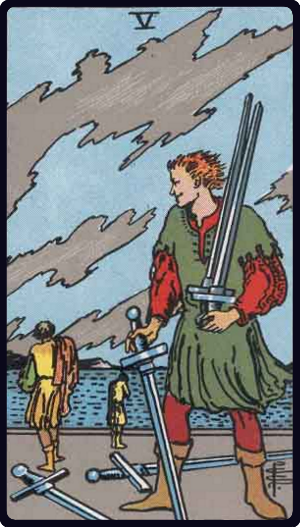
The image shows one figure collecting swords while two others leave the scene. The central figure looks towards the retreating people with an ambiguous expression as a troubled sky hangs over the water.
The swords in hand and on the ground suggest a contest has ended, but the emotional outcome remains unsettled. The distant figures appear defeated or disengaged, raising questions about humiliation and the price of victory. Jagged clouds echo the tension, while the water hints at feeling beneath the intellectual or verbal struggle. The image leaves motive open and focuses attention on consequences.
Your moment of reflection
In this conflict, what outcome would protect your dignity without asking you to abandon your values?
You might like to sit with this question, write without editing for a few minutes, or simply notice what answer keeps returning.