
When Four of Swords appears upright
Detailed upright meaning
You may need a genuine interval between what has happened and what comes next. The Four of Swords appears when constant thought or activity has reached the point where more effort is unlikely to create more clarity.
Rest here is intentional. It does not require disappearing indefinitely or abandoning responsibility. It may mean reducing input, postponing a non-urgent decision, taking quiet time after conflict or creating a temporary boundary around your attention.
The mind often continues working beneath the surface when conscious effort stops. A problem that feels tangled late at night may look different after space, food or sleep. This is not a medical promise; it is recognition that cognition and capacity have limits. Rest can change the conditions in which you meet the question.
The card may be particularly relevant after the intensity of the Three of Swords. Pain does not always need immediate interpretation. Sometimes the kindest response is shelter: fewer explanations, fewer demands and enough quiet to let the nervous urgency soften.
Contemplation differs from rumination. Contemplation gives a thought room and then allows it to rest. Rumination circles the same material while increasing distress. If your pause is filled with relentless analysis, a gentle structure may help: write down the concern, choose when to revisit it and bring attention to something sensory or ordinary.
Solitude can restore you, but the Four does not insist that healing happen alone. You may need practical support so that rest is possible, or the calm presence of someone who does not require you to perform conversation. Receiving that care does not weaken the value of your retreat.
Rest is also shaped by circumstance. Not everyone can step away freely, and advice to simply do less can ignore caregiving, financial or workplace realities. Look for the smallest available reduction rather than blaming yourself for conditions you did not create.
The invitation is to protect a meaningful pause and let it have a purpose. Rest before every reserve is spent, make fewer decisions where possible and trust that stillness can be preparation rather than absence.
When Four of Swords appears reversed
Detailed reversed meaning
The pause may be interrupted, resisted or stretching beyond what feels restorative. The Four of Swords reversed can reveal restlessness, exhaustion or uncertainty about how to re-enter ordinary life.
You may know that rest is needed but find yourself unable to settle. The body is still while the mind rehearses tasks, conversations and possible outcomes. Trying to force calm can become another performance. Instead, reduce the demand: a quieter hour, a slower pace or a single source of input may be more accessible than perfect stillness.
The reversal can point to returning too soon. Pressure, guilt or the fear of falling behind may encourage you to resume full capacity before it is available. Where you have choice, consider a graduated return and clearer limits. Where you do not, seek practical support rather than interpreting strain as personal weakness.
Burnout may also be relevant, but a tarot card cannot diagnose it or any health condition. Persistent exhaustion, sleep disturbance or distress deserves appropriate professional care. The card can only invite reflection on workload, recovery and the systems surrounding you.
In another expression, retreat has become isolation. Time alone may once have protected you, but now it could be making reconnection feel harder. Begin gently. One low-pressure message or a small return to a familiar place can test whether contact offers nourishment.
You may also be emerging from a necessary pause. Energy or interest is beginning to return, but there is no need to compensate for lost time through immediate overactivity. Carry something learned from the quiet into the new pace, or the same pattern may quickly rebuild.
Rest can be undermined by unresolved practical demands. If your mind keeps returning to one task, write the next action clearly or ask for help. Sometimes calm arrives not from ignoring a responsibility but from placing it inside a trustworthy plan.
The invitation is to make recovery more honest. Adjust the form of rest, reduce isolation or protect your re-entry from unnecessary urgency. Restoration is not measured by how quickly you become useful to everyone else again.
Four of Swords in love
Love and relationships
Space may help a relationship settle after tension or emotional intensity. The Four of Swords can reflect a respectful pause, quiet companionship or time to understand your own response.
Reversed, distance may be creating uncertainty or a conversation may have been postponed too long. Space works best when its purpose and boundaries are communicated rather than used to control, punish or disappear.
Four of Swords at work
Career and money
A pause may improve perspective before you make the next professional move. The Four of Swords supports review, recovery after a demanding period and reducing avoidable decisions where possible.
Reversed, workload or worry may be preventing meaningful rest. Tarot cannot determine health, employment or financial consequences. Use workplace processes, accurate information and qualified support for decisions that affect your wellbeing or security.
Four of Swords as spiritual guidance
Spiritual guidance
Silence can create space for insight that cannot be forced through effort. The Four of Swords invites contemplation, simplicity and a temporary release from the need to interpret every experience.
Reversed, stillness may feel inaccessible or spiritual retreat may have become avoidance. A grounded practice can be brief, embodied and connected to ordinary life rather than perfectly serene.
Reading the traditional image
Imagery and symbolism
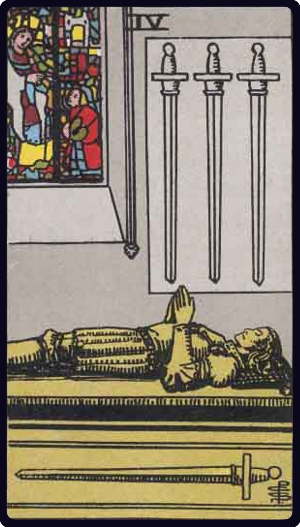
The image presents retreat as a protected interval shaped by reflection. A stone figure lies with hands together inside a quiet sanctuary; one sword rests beneath them while three hang on the wall.
The horizontal posture suggests stillness after struggle, and the enclosed setting creates shelter from external demands. A stained-glass window introduces colour and connection beyond the resting figure. The three suspended swords may represent difficulties temporarily set aside, while the single sword below remains available for later action. The scene resembles a tomb, yet its message is pause and contemplation rather than a literal prediction of death.
Your moment of reflection
What kind of pause would help you return to your life with more presence rather than simply more endurance?
You might like to sit with this question, write without editing for a few minutes, or simply notice what answer keeps returning.