
When Three of Swords appears upright
Detailed upright meaning
Something may hurt precisely because it mattered, and the Three of Swords gives that pain room to be real. This card appears when disappointment, separation or an unwelcome recognition cuts through the story you hoped to keep.
Its image is stark, but it should not be used to predict betrayal, infidelity or loss. Tarot cannot establish what another person has done or what happens next. The card is more useful as a reflection of pain already present, feared or becoming consciously understood.
Swords belong to thought and language, suggesting that words, information or interpretation may be closely tied to the hurt. A conversation could have changed how you see a relationship. A truth may conflict with what you wanted to believe. You may also be revisiting something said long ago and recognising its impact more fully now.
Emotional honesty does not require turning pain into a permanent identity. It asks you to stop arguing with the fact that the experience affected you. Minimising it because others have suffered differently, or because you think you should be over it, adds judgement to what already hurts.
Grief can contain several feelings at once: sadness, anger, relief, longing or confusion. There is no need to arrange them into a clean sequence. Let the experience be complex without assuming that intensity provides a complete account of the situation.
The Three can also reveal the pain of a necessary truth. A boundary, ending or recognition of incompatibility may be right and still cause heartbreak. Sound decisions do not always feel peaceful immediately. Sometimes integrity and grief occupy the same moment.
Be careful with the mind's search for a single explanation. Analysis can offer meaning, but it can also keep reopening the wound in the hope that one more thought makes the event different. Ask whether reflection is bringing understanding or rehearsing injury.
This card offers no glossy shortcut. It invites support, gentleness and enough space for pain to move at its own pace. What hurts deserves care, not a frightening prediction. Acknowledgement can become the first form of release.
When Three of Swords appears reversed
Detailed reversed meaning
Pain may be loosening its hold, although healing can remain uneven and unfinished. The Three of Swords reversed can reflect recovery, the release of an old story or grief that has been pushed out of sight.
You may be noticing that a memory no longer controls the whole day, or that you can speak about what happened with greater steadiness. These changes can be quiet. Healing is not invalid because you still have difficult moments, and a difficult moment does not erase the movement already made.
Forgiveness is sometimes associated with this reversal, but it should never be demanded. You can release your ongoing involvement with an injury without excusing it, restoring access or reconciling with the person involved. The shape of repair belongs to you and should account for safety, accountability and actual change.
In another expression, the reversed card suggests suppressed grief. You may appear functional while avoiding any pause in which feeling could catch up. This strategy may have helped you meet immediate demands. When enough safety and support are available, allowing some honest emotion can be more sustainable than carrying it silently.
Lingering hurt may also influence present situations. A new disappointment can activate the meaning of an older one, making the response feel larger than the current event alone. This does not make the feeling irrational. It may show where previous pain still needs compassion or a different kind of support.
The reversal can indicate repeated mental replay. You might imagine alternative words, search for hidden details or rehearse the injustice in an attempt to regain control. Give reflection a boundary and return attention to what is available now. If distress feels persistent or difficult to manage, qualified mental-health support offers care beyond what tarot can provide.
Reconciliation with truth may be the deepest movement here. You do not have to prefer what happened in order to stop negotiating with its reality. Acceptance can mean freeing present choices from an endless attempt to rewrite the past.
The invitation is compassionate release, without deadlines or performance. Let pain become one part of your experience rather than the lens through which every future possibility is judged.
Three of Swords in love
Love and relationships
A relationship may be carrying heartbreak, disappointment or a truth that changes how connection feels. The Three of Swords can reflect hurt, distance or grief, but it does not confirm betrayal or predict separation.
Reversed, repair or emotional release may be possible, though reconciliation is not always the right form of healing. Look for honest communication, accountability and consistent behaviour rather than relying on the card to reveal another person's intentions.
Three of Swords at work
Career and money
A professional disappointment or difficult piece of feedback may need honest processing. The Three of Swords can reflect rejection, conflict or the loss of an expected path.
Reversed, perspective may be returning and a different direction may become easier to consider. Tarot cannot predict employment or financial outcomes. Use current information and appropriate professional guidance when practical decisions carry significant consequences.
Three of Swords as spiritual guidance
Spiritual guidance
Spiritual practice can make room for sorrow without demanding that it become a lesson immediately. The Three of Swords invites honesty in place of forced positivity.
Reversed, meaning may begin to emerge after the pain has been respected. Be cautious of teachings that frame suffering as deserved, spiritually necessary or proof that you failed to think correctly.
Reading the traditional image
Imagery and symbolism
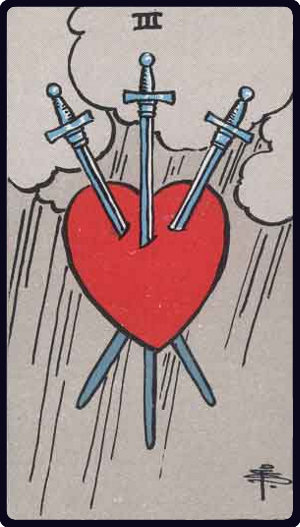
The image makes emotional pain visible without distraction. Three swords pierce a red heart beneath heavy clouds and falling rain.
The heart represents feeling and vulnerability, while the swords connect the wound with truth, thought or language. Rain suggests grief expressed rather than contained, and the grey sky creates an atmosphere in which there is little room for denial. No people appear in the scene, keeping attention on the experience itself instead of assigning blame or constructing a fixed story about its cause.
Your moment of reflection
What pain becomes more bearable when you stop asking yourself to minimise, justify or rush beyond it?
You might like to sit with this question, write without editing for a few minutes, or simply notice what answer keeps returning.